No New Panel for Late Sup. Report

Pop quiz, dear readers.  You requested a supplemental report from a panel qualified medial evaluator, providing all treatment reports not available at the time of the original evaluation.  Sixty days later, there’s no report.  What happens?

Well, if you reach for the panel case of Lopez v. C&S Wholesale Groceries, you would say yes – a party who doesn’t get a supplemental report in 60 days, as required by California Code of Regulations section 38(h).

On the other hand, if you were to look at the panel case in Ramirez v. 3 Day Blinds Corporation, the answer would be no.

So, now we have yet another panel case, this time, Garcia v. Loaves and Fishes of Contra Costa, which again finds that no new panel is necessary.

The facts are a bit convoluted though, so bear with me (your humble blogger is not ignorant of the fact that today is Monday and the line at Peet’s Coffee was too long to tolerate today).

Defense counsel requested a supplemental report from the Panel QME, and more than sixty days later, no report was available.  Naturally, the defense filed an objection and requested a replacement panel, so the matter proceeded to hearing.

Apparently, the QME was in the process of moving his office, and didn’t get the request for a supplemental report.  Under the MSC judge’s guidance, the QME’s deposition was set and the issues raised in the original request for a supplemental report were apparently addressed.

But… shouldn’t the defendant be entitled to a new panel?

No.  In this case, the factors seemed to weight against issuing a new panel.  The transition of the PQME’s office provided a reasonable excuse for the failure to respond in a timely fashion, and the fact that the QME made himself available for deposition also relieved some of the harm done to the defense.

The WCAB denied defendant’s petition for removal and the Court of Appeal denied review.

Now, dear readers, we’re all grown men and women, so I’m going to be frank with you.  As previously revealed on this blog, there is no Santa Clause, the Easter Bunny does not exist, and late reports are excuses for a replacement panel.

Both sides do this and regularly – if a QME is favorable to your side, the report can be one day late or 45, you won’t object because you don’t want a new QME.  At the same time, if the QME’s office regularly rings with “quacking” noises, you’re probably going to look for any excuse to get rid of him, including a one-day late report.

The WCJ is absolutely correct – although there is a very firm deadline of 60 days for a supplemental report, there is no requirement that a replacement panel issue.  On the other hand, we know that a replacement panel is a remedy some judges are ready to provide for a late panel, and the inconsistency can be pretty frustrating (as is common with many things in the comp world).

Now, bear in mind, dear readers, that your humble blogger is not committed to one camp or the other.  When a defense-friendly QME is a month late with his report, it’s silly to issue a whole new panel and start the process over.  On the other hand, when a defense-hostile, drug-dealing, good-for-nothing QME can’t get his act together to get a report out in 60 days, justice demands he get the boot and a new panel issue.

What we need is a consistent rule, or some citeable authority, so we know ahead of time what’s going to happen with a late report, and what the consequences are.  If we had such a rule, perhaps we could avoid unnecessary litigation on this point.

However, until the WCAB gives us a solid, binding rule, one way or another, we can expect to take our chances with this again and again.

What do you think, dear readers?  What should the rule be?  If the report is late, should a party get a replacement panel on demand?  Should the right to request a panel be limited to the party that submitted the request for a supplemental report?  If a new panel is not the remedy for a late report, what should the remedy be?

I can think of a few alternative remedies:  If the report is late, the bill should be reduced by some amount.  The late report might generate a citation which, along with other citations, should lead to a probation status as a QME (and perhaps probation status can have a mandatory reduction in the statutory fees to which QMEs are entitled).

In the meantime, dear readers, keep those DORs handy, the calendars current, and your fingers crossed.

Have a good week!

Automation of Work Force Continues: Panera Bread to Replace Human Cashiers w/ Kiosks

As my beloved readers will no doubt recall, their humble blogger offered them a cocktails of prophecy and pessimism that went down with a fight.  I had the great displeasure of reporting to you the growing interest and trend in automation of the food service industry, replacing a large group of workers with a growing price tag with reliable and sterile machines.

The trend continues.

Panera Bread is reportedly replacing several cashier positions with automated touch-screen ordering systems.  The reported goal is to have all cashiers replaced with touch-screen ordering kiosks by 2016.

Meanwhile, just yesterday, mass protests by fast-food workers demanded a minimum wage of $15.

Do you see where this is going?

Let’s take a look at France, for example.  In France, the minimum hourly wage is $12.22 per hour.  That’s great, right?  Well, this is nothing new, and in 2011, McDonalds installed 7000 automated kiosks to replace all of its cashier positions.

Robots don’t get injured.  They get damaged – but that only provides employment to mechanics and those fresh-faced Silicon Valley programmers.

If we continue to see large, loud, and labor-driven protests and demonstrations for a higher minimum wage, we can expect to see more investment in automated technology to replace workers with robots.

That, of course, will leave a lot of really good people out of work (namely workers’ compensation defense attorneys and adjusters).

So, when you’re chatting it up with your friends and one of them valiantly declares his intent to lobby or vote for a higher minimum wage, remind him that he may be pushing for higher unemployment and robotization of the work force.

Have an efficient and automated weekend, dear readers!

No RFA Form? No Need for UR

So, here’s a puzzle for my dear, beloved readers: you receive a PR-2 in the mail, and, as part of the PR-2, there’s a request for authorization of treatment (the good doctor wants to give the injured worker a jetpack to help his self-esteem).

How many days do you have to perform UR on the request for the jetpack?

Does the clock start ticking once you realize that it’s a request for authorization?

A recent panel decision addressed this very issue:  The defense issued its UR denial on the sixth day, and applicant made the argument that it was late.  By contrast, the defense argued that without a Request for Authorization form, it was under no obligation to perform UR at all.

The WCJ, in finding for the defense, relied on California Code of Regulations section 9792.9.1(a), which holds that a request for authorization must be on the DWC RFA form.

As so properly put by the WCJ in his report, unless the RFA form is properly filled out and submitted, “no request for authorization has occurred.”

The WCJ rejected applicant’s argument that the defense waived any objection to form (or lack therefore) by performing UR, but I would be careful – other WCJs and other panels might go the other way, and reason that once the defense is aware that this is a request for authorization, it needs to perform UR.

In fact, as my dear readers will recall, the panel case in Musetti v. Golden Gate Disposal & Recycling went the other way, where the WCAB reasoned that defendant’s objection to a faulty PR-2 treatment request started the time to refer to UR.

Accordingly, it makes sense to reflect on an adopt a consistent policy of what is to be done with treatment requests not submitted on a RFA form – UR or waste bin?

The panel decision?  Torres-Ramos v. Felix Marquez; Redwood Fire & Casualty Company.

Unable to Lift His Baby, Fraudster Filmed Playing Basketball at YMCA

“Oh man, Mr. Adjuster, it hurts so bad.”

“How bad does it hurt, Mr. Bolton?”

“Oh, so bad… I can’t stand for more than an hour at a time.  I can’t even pick up my baby girl… think of the psychiatric injury I’m developing by not even being able to pick up young child… can you get those TTD checks out?  Maybe some PD Advances…?”

“Uhhh… sure, I guess…”

“Great!  Now I’ve got to get down to the Y – the boys and I got a game going.”

Now, your humble blogger isn’t claiming that this exchange happened word-for-word, but that’s the conversation this defense attorney conjures up in his head when he hears the story of Chip Kyle Bolton, who apparently told the adjuster that his work injury caused some pretty serious harm on the same day he was videotaped playing basketball and exercising at the YMCA.

In addition to his workers’ compensation fraud Mr. Bolton was convicted for welfare fraud.  Apparently, the judge that sentenced Mr. Bolton to eight years and eight months in Monterey County Jail, called him a “perennial liar.”

It is no secret that your humble blogger is glad to see the workers’ comp fraudsters go down.  The guys that rip off their insurers and employers ultimately drive up the prices for the rest of us.  So this is another win for the good guys.

In the meantime, Mr. Bolton has been ordered to pay restitution, the workers’ comp end of it being about $60,000.  Of course, money ill-gotten and quickly spent is not easily recovered, even by the state.  So while we all get to nod approvingly at justice being done, it is more likely than not that the money will never be seen again.  But that is just typical for workers’ comp fraud, and why it is so devastating to the public.

No Psyche Injury for a Truss Fall

When your humble blogger was just knee-high to a grasshopper, long before he was the freakishly (and handsomely) tall workers’ compensation defense attorney that sits before this very screen, my uncle Joe sat me down on his knee and gave me a very important lesson.

“Sometimes,” he said, “people get hurt at work, and sometimes those injuries cause psychiatric injuries as well as physical ones,  but those injuries are barred by Labor Code section 3208.3(h) unless the employee has been with the employer for at least six months, or the injury is resulting from a sudden and extraordinary event.”

My uncle Joe was a wise man, and this subsection has come to bar many claims.  Recently, the Court of Appeal denied applicant’s writ of review of a WCAB decision finding that applicant’s injury was NOT extraordinary when his tool belt caught on a 250 pound truss causing it to fall on him, injuring his left side.  (Alves v. SCIF)

There wasn’t much dispute that the injury was sudden, but extraordinary?  Does applicant have a case?  What do you think, dear readers, if a 250-pound truss suddenly fell on a carpenter version of you, would it be extraordinary?

Well, the WCAB, in reversing the WCJ, found that applicant’s claim was defeated by the “extra-ordinary element.”

Rejecting the WCJ’s report, which relied on the panel case in Matea v. WCAB (2006), wherein a Home Depot employee to find that a pile of logs falling on a worker’s leg was both sudden and extraordinary, because, in this case, the two are not the same.  In the WCAB’s opinion, the falling of a truss was NOT extraordinary, because it could happen at any time when anything, including a tool belt gets caught on it.

The WCAB also relied on the Court of Appeal case in Bayanjargal, which held that a roofer’s fall from a roof was not an extraordinary injury.

Now, there’s an important lesson to take away from this – don’t be disheartened if the case doesn’t work out at the trial level.  The defendant in this case didn’t and it came back with a victory.  Why?  Because there is an undeniable level of subjectivity in this analysis – like jurors in a tort civil trial, the WCAB commissioners and the WCJ are asked to determine what is reasonable expected in any given industry, which it is unlikely the commissioners and WCJ’s had been engaged in themselves.

So, if you take a hit at the trial level on a 3208.3(h) case, don’t be shy about a petition for reconsideration.

Have a great weekend, folks!

Applicant Charged with Identity Theft for Using Another’s Social Security No.

Once in a while, after a private investigator runs a social security number, he or she may notice that there are several people associated with the same social security number.

Unless it is a case of a real-life Multiplicity (great movie, by the way, despite what those jerk critics said), what you probably have is someone who is an illegal alien purchasing a cloned social security number in order to get a job.

Often enough, employers look the other way because they want the cheap labor, but sometimes it’s just a case of pure fraud with the employer as much a victim as anyone else.

If this fact floats up during the defense of a workers’ compensation claim, the obvious position to take is that neither supplemental job displacement benefits, nor a return to work, are any longer entitlements of the allegedly injured employee.

A recent story, however, reflects that sometimes law enforcement organs of the state are ready to prosecute the criminal side of this fraud as well.

It appears that Blanca Rodriguez has been charged with two counts of felony identity theft by the San Bernardino County district attorney’s office.  She allegedly used someone else’s social security number to file a workers’ compensation claim, and received benefits.

An injured worker might want to use an ill-gotten social security number for several reasons, not the least of which is to try to conceal the existence of past injuries.

The employer, however, can benefit from a fraud conviction by using it to derail the credibility of the applicant as to all claims: a WCJ would have to document why, despite the fact that the injured worker is a proven fraud, that workers’ compensation claims are truthful.

Some district attorneys, however, don’t want to pursue prosecution for workers’ comp fraud committed by the injured worker.  The District Attorney of each county is elected, of course, and might do the voter calculations to favor workers over employers and insurers.  In those cases, uninsured employers can expect to feel the cold bite of justice, but employees can rest assured that their crimes will not be addressed.

It is no secret that this humble blogger is pleased to see a District Attorney pursuing justice and the proper discharge of the duties entrusted to the office.  As for all of us civilians, this should serve as a reminder that the social security number can be a valuable tool in verifying information and discovery fraud.

Capping PD at 200%

Capping Permanent Disability at 200%

Everyone knows that the intent of the legislature was to allow injured workers to have a maximum of 100% permanent disability per injury – not once, but twice.  What’s that you say?  Labor Code section 4664 says that “[t]he accumulation of all permanent disability awards issued with respect to any one region of the body in favor of one individual employee shall not exceed 100 percent over the employee’s lifetime”?

Apparently, in California’s workers’ compensation system, a “lifetime” is defined as before and after SB-899.  For pre-2005 injuries, the injured worker gets one “lifetime” under the old rating schedule.  The other “lifetime” is for injuries sustained after January 1, 2005, or pre 1/1/05 injuries where there is a report documenting the existence of permanent disability after January 1, 2005.  Additionally, there is an argument to be made that any injuries sustained while watching the Lifetime channel would also be compensable.

Well, consider the case of Seafus v. County of Los Angeles, a recent writ denied case.

Applicant had sustained a cumulative trauma to the psyche culminating in 1998 to the heart, cardiovascular system and psyche, and the case was resolved by stipulation in 2004.  Specifically, the 2004 award was for 70% permanent disability, and the award reflected that applicant “is restricted from undue stress and substantial work for slight heart disease.”  The applicant then claimed another injury, allegedly sustained in 2006, also to the heart, cardiovascular system, and the psyche.

Naturally, the defendant sought apportionment, but the Agreed Medical Evaluator (be really, really careful when you pick an AME!) opined that there was no overlap between the two injuries, although 15% of applicant’s permanent disability was apportioned to the 1998 cumulative trauma under Labor Code section 4663.

In relying on the AME’s reports, the WCJ reasoned that the actual medical documentation for the prior cumulative trauma supported a preclusion from “very heavy work” rather than the “substantial work for slight heart disease” listed in the actual award.

Also, it did not appear that the AME in the instant case was able to convert the 1998 injury to AMA Guide ratings to allow for apportionment.  The WCJ then issued an award finding 87% permanent disability, less 15% apportionment, from applicant’s new injury.  Finally, in rejecting defendant’s argument that Labor Code section 4664(c)(1) prohibited a finding of 157% permanent disability, the WCJ reasoned that Sanchez v. County of Los Angles (en banc), held that 4664 apportionment requires overlap of disability, rather than the same body region.

In this case, the AME did not find an overlap in disability, although the body region appears to be the same.

The WCAB denied reconsideration, and the Court of Appeal denied review.

Your humble blogger has a few problems with this result.  First of all, it is not appropriate to disturb an award or even challenge its validity so many years after the fact.  The original Award was issued in 2004, and the trial for the new injury was held in 2013.  9 years after the Award was issued, and 15 years after the original injury is the wrong time to question the adequacy of the original Award.

As for the rest, a person who is 70% permanently disabled is just that – 70% permanently disabled.  It should matter what rating schedule we used – if you were 70% disabled in 2004, you’re still 70% disabled in 2005, and now that you’re 87% permanently disabled doesn’t mean that you were free of permanent disability at the time you were evaluated.  And yes, dear readers, your humble blogger is well aware of that “fighting word” “Minvielle” from the panel decision of Minvielle v. Contra Costa Fire Protection District, holding that there is no overlap between 1997 schedule work preclusions and factors of disability on the one hand and AMA whole person impairment on the other.  That being said, that writ denied panel decision is hardly controlling law and its rejection should be argued for with the same frequency that Carthage’s destruction must be demanded in the Roman Senate.

2nd Hand Smoke = Serious and Willful

For those brave souls that take Mad Men as gospel, smoking was a big part of life at one point in the United States.  Everybody, or almost everybody, smoked, and the smell of smoke was just another part of life.

moredoxsmokeluckies-notext-400x400

Well, things have changed.

Entire restaurants, rather than mere sections, are now “no-smoking,” and each legislative session shrinks the area where a person can enjoy fine tobacco products.  In some cities, Davis, CA, comes to mind, smoking is even prohibited in your own home.

So, why should the workplace be any different?

In 1994, the California Legislature adopted Labor Code section 6404.5, which effectively banned smoking within enclosed work spaces.

It appears that violation of this law can now lead to liability for Serious and Willful Misconduct in the workers’ compensation arena.

Consider, if you will, the case of Blaylock v. Negherbon Auto Center.  Mr. Blaylock, a gentleman suffering from asthma, was constantly required to spend long periods of time in the enclosed office of the Finance Manager, who smoked on a regular basis in her office.  The record reflects that he complained frequently about his deteriorating health from having to constantly breathe in the smoke from the finance manager’s cigarettes, but even his eventual trip to the emergency room did not slow or stop her smoking in his presence (or rather, requiring his presence while she smoked).

Applicant was ultimately found totally permanently disabled, and pursued the increased benefits allowed for serious and willful misconduct.

The defense seemed focus on the fact that the employer did not know it was violating the law, and was not aware of Labor Code section 6404.5.  However, the workers’ compensation Judge was not persuaded – reasoning that it is unlikely that an employer was completely unaware of the change in the law, and that the use of the term “enclosed space” by the management reflected at least some knowledge of Labor Code section 6404.5.

Now, it’s important, when considering the merits of this case, to recall that the world was a very different place when applicant had to go to the emergency room in May of 1998.  Smoking was still much more common-place than today, and it is possible that the employer was aware of “a law” and incorrectly interpreted it to mean that, so long as she kept her smoke in her office and not in the general work area, she would be fine.

But, another factor in this was credibility – the WCJ found the applicant to be credible, and the finance manager to be not credible, and such a finding is typically the subject of the WCAB’s deference.

The WCJ found for the applicant, WCAB denied reconsideration, and the Court of Appeal denied review.

The country has changed, and California has changed as well.  Smoking tobacco is not as socially acceptable as it once was, and there is considerable public sentiment against tobacco now-adays.

It will be interesting to see, in the coming years, if the pendulum will swing the other way to require employers to allow medicinal marijuana smoke at work while prohibiting tobacco.

In the meantime, you should probably lay off the whole “forcing employees to inhale second-hand smoke” management style (just a thought).

Have a great weekend!

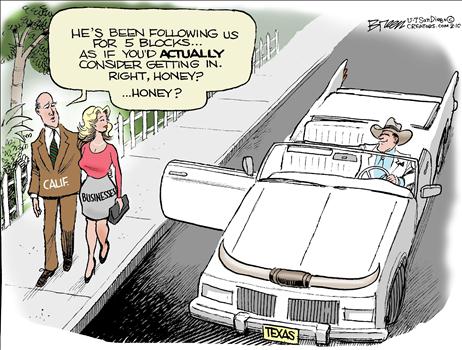
California Drives Away Toyota Jobs

THIS IS WHY WE CAN’T HAVE NICE THINGS.

It looks like California is losing about 3000 jobs, as Toyota recently announced that it plans to move its headquarters from Torrance, California to Plano, Texas.

Although some 2000 jobs will remain (for now), a lot more are trading in their marijuana and grapes for 10-gallon hats and guns.  Yee Haw!

What could possibly have prompted Toyota to move from California to Texas?  Well, your humble blogger’s understanding is that the cost of doing business may have had something to do with it.

texas-seduction-cartoon

For example, in 2010, the average premium paid in workers’ compensation insurance in California for every $100 in payroll was $2.29.  So, on average, an employee making $40,000 per year cost $928 per year just in workers’ compensation premiums.  By contrast, in 2009, Texas had a subscriber premium of $1.47 for every $100 of payroll.  That same employee, earning $40,000 per year, would only cost a Texas employer $588, or almost half.

So, by moving to Texas, Toyota could expect to save $2,460 for every $100 in payroll for those 3000 jobs.  If we were to assume that the average Toyota job moving to Texas will be offering $40,000 in annual payroll, Toyota moves to save around $1,000,000 per year in workers’ compensation premiums alone.

That doesn’t factor in that Toyota will have the option to opt out in Texas, nor do those numbers reflect that California’s costs have gone up while Texas continues to be more affordable.

Mind you, again, dear readers, that the cool million dollars is for workers’ compensation premiums alone, and not the host of other fees, taxes, licenses, lawsuits, and other schemes, graft, and harassment Toyota can look forward to avoiding by fleeing California.

Now, don’t get me wrong – I love it here in California.  I love the weather, I love the food, and I love a good portion of the people, excluding that sizeable and significant minority – the lawyers.

But we’ve got to get this thing fixed.  Toyota is not the first business to leave and it certainly won’t be the last, and California’s workers’ compensation system, much like the pantheon of regulations and liabilities for employers big and small, are slowly but surely strangling us.

Accordingly, the most effective route of this mess is to gather up all the members of California’s Legislature, and organize a field trip to a sheep farm.  There, the farmer can demonstrate to California’s elected representatives, that you can sheer a sheep many times, but only skin it once.  California needs less leather and more wool.

Game Show Fraud Fail

From time to time, your humble blogger has offered advice to his beloved readers.  Sometimes this is in a one-on-one e-mail exchange, and sometimes it is offered more broadly as part of a blog post.  But, as with all things, one gets exactly what one pays for, and free advice is no exception.

Today, however, your humble blogger offers this advice upon which he is ready to stake his professional reputation.  If this advice leads you astray, may the mighty deities of the California Bar strike my license down in all their righteous vengeance.  The following advice is submitted for your consideration:

If you are claiming an industrial injury which precludes you unable to stand, run, reach, or grab, DO NOT (and your humble blogger, despite his linguistic skill and rhetorical expertise, simply is incapable of articulating this prohibition with sufficient gravity) appear on a nationally broadcast television show in which you jubilantly, and without the slightest sign of pain, repeatedly stand, run, reach, and grab.

Now, to some of you, this may appear obvious, and no advice at all.  This may seem as common sense that should be discarded, as your own most natural instincts of self-preservation would keep you from doing this, while your inclinations of honor and honesty would stop you from lying about your injuries in the first place.

For the rest of you, please consider the story of Ms. Cathy Cashwell.  Ms. Cashwell claimed an industrial injury to her shoulder for which she was apparently receiving $3000 (or there about) in workers’ compensation benefits, when she went on The Price is Right.  She clapped, she bounced, she ran, she jumped, she hopped up and down as happy as a clam, and she even got to spin the big wheel.

Law enforcement officers were not impressed.

Now, normally your humble blogger would not waste your time with a non-California case or story, as wasting your time with California issues is sufficient to make me happy. However, this is a story that is a bit hard to pass up in relating.

When I was diligently working in the Insurance Fraud Unit at the District Attorney’s Office, my old mentor imparted some valuable law enforcement advice: “we don’t catch the smart ones.”

Ms. Cashwell pleaded guilty to fraud back in 2013, but your humble blogger just became aware of this case recently.  May this blog post be the most frustrating experience you face this week!