
Unpublished COA: Guzman Ratings Not Just For Complex or Extraordinary Cases

UPDATE: As of 1/15/14, this case is now PUBLISHED and citeable.

Hello, dear readers!

Welcome to the first full week of 2014.  Vacationers are returning to clog up our commute, our co-workers are filling the cubicles next to ours, and, in the most merciful of small mercies, all the kids are returning to school.

So, what better way to start off this full week of 2014 than to bring you another disappointing (yet, blessedly unpublished) opinion from the Court of Appeal on the breadth and scope of Almaraz/Guzman.  The case is that of City of Sacramento v. WCAB (Arthur Cannon).  The facts are fairly simple as well: Mr. Cannon sustained an injury to his left foot, plantar fasciitis, which does the evaluating physician found had no ratable impairment.

However, in considering the impairment under the Almaraz/Guzman case, which is a favorite among the defense community (right?), the AME provided a 7% whole person impairment, based on “having a limp, despite the absence of any arthritic changes about adjacent joints.”

See, defendant Sacramento sought to have the A/G rating rejected because plantar fasciitis is not “complex or extraordinary.”  The Workers’ Compensation Judge agreed, and elected to use the straight rating.  (Here’s a fun fact: if you are at a table with nine of your friends, odds are that at least one of you will have plantar fasciitis at one point in your lives.)

On reconsideration, agreed with Mr. Cannon, however, reasoning that the injury does not have to be complex or extraordinary to warrant an A/G rating.  Unfortunately, on appeal, the COA agreed.

The COA reasoned that Guzman III wasn’t LIMITING the use of alternative ratings to complex or extraordinary cases, but just providing another scenario when A/G should be used.  Specifically, “the Sixth District was using the term ‘complex or extraordinary cases’ to describe ‘syndromes that are “poorly understood and are manifested only by subjective symptoms,”’ which the AMA Guides do not, and cannot, rate.”

The thrust of the problem is that the AMA Guides might not provide a rating for conditions that manifest themselves only subjectively.  But is this a problem?  Surely the writers of the AMA Guides had at least some experience with medicine and treatment… they knew these conditions existed and, for whatever reason, did not want to provide impairment rating.

But, that being said, your humble blogger is with Sacramento on this one.  When the Sixth District tells us that the Guides intended to allow physicians to deviate from strict interpretation of the Guides in certain cases, and in THOSE complex or extraordinary cases the Guides allow for some sort of deviation, what else are we to think?

Hopefully, we’ll get some sort of authority soon that will effectively limit the application of A/G.  Right now, the bar is fairly low for performing an alternative rating and having it stick, and, as common as people with plantar fasciitis, alternative ratings result in increased WPI.

Now, bear in mind, if any applicant’s attorney waves this case in your face, you can point to Rule of Court 8.1115(a), but it is not a pleasant thought to know that the inclination of the WCAB is to allow an A/G rating for any reason.

2007 Wood Chipper Death Results in Employer Fraud Discovery

Welcome back, dear readers!  2013 is gone (though not forgotten) and 2014 is here to usher in a new era of prosperity, joy, and peace… or maybe just more of the same – we’ll see!

One wonderful way to kick off the new year is a story about Jose Luis Guerrero, who, through his company Jose Martinez Tree Service Inc., under-reported more than $2 million in payroll over four years (March of 2005 to March of 2009).  He reported primarily clerical workers to State Compensation Insurance Fund, but his genius plan began to unravel when someone at SCIF noticed claims for a serious car-crash injury, and, later, the death of one worker after he FELL INTO A WOOD CHIPPER.

Does that happen a lot at your office, dear readers?  In my experience, most clerical workers are trained in avoiding the wood chipper that most offices place between the copy machine and the office fridge.

After a thorough investigation by SCIF and a prosecution by the District Attorney’s Office, Mr. Guerrero plead guilty to several counts of evading taxes, making fraudulent statements to reduce premiums, and making fraudulent statements to obtain or deny compensation, as reported by KFI AM.

It also appears that Mr. Guerrero plead guilty to possession of an assault weapon, so if you suddenly stop receiving these blog posts, you’ll be able to put two and two together.

Now, your humble blogger is not suggesting that Mr. Guerrero’s failure to properly report the nature of his business and the number of his employees lead to the anyone’s death or injury.  Quiet the contrary – by fraudulently avoiding costs there should have been more money available to provide safety equipment and a less hurried work schedule.

But, what your humble blogger is curious about, is who drafted this policy and who sold him this insurance?  We’re talking about a business called Jose Martinez Tree Service, and there is a huge clerical population among the employees?  Obviously, the fault lies with the now-convicted, but SCIF, like every insurer, should regularly make sure that whoever is selling its policies engages in due diligence.

Welcome to 2014!

More on Nurse Case Manager Selection

Nothing ruins a Friday for a cold-hearted workers’ compensation defense attorney than having to side with the arguments of an applicant.  Well, probably a few things could make a Friday worse (like realizing that it’s only Thursday), but that’s one of the bad ones.  So it is, as your humble blogger has learned of the case of David Pelletier v. United Structures, Inc.

The subject of this case is the degree to which an applicant has control over the selection of a Nurse Case Manager.  Now, workers’ compensation is riddled with these battles over control: who gets to pick the interpreter for applicant’s deposition?  Applicants get to pick the QME from the panel, but only if unrepresented.  The defense gets to set up an MPN and provide a list of potential primary treating physicians, but applicants get to choose from those primary treating physicians.  How is venue selected when the residency, place of business, and injury are all in Northern California, but applicant’s attorney is in Southern California?

Well, this blog has had occasion to touch on the issue of Nurse Case Manager selection before, and the Pelletier case seems to revisit the subject.

Mr. Pelletier had a Nurse Case Manager who, from the panel opinion, appeared to like to appear by e-mail.  The NCM kept in touch with applicant’s treating physicians, applicant, and his family by e-mail.  Even as applicant was in the hospital for several days, repeatedly having his stay extended just prior to planned discharge, the NCM declined to appear in person to discuss what was going on with the doctors.

The NCM was repeatedly asked to come by applicant, his attorney, and his family, as potential amputation of the leg was being discussed by one of his treating physicians.  Still, the NCM declined to come.

Eventually, applicant informed the NCM that he would no longer have contact with her, and demanded a new NCM, one with whom he could work: trust, communication, etc.  The defense refused, and the matter went before a Judge.

The WCJ denied the applicant’s motion for a new NCM.  Citing Lamin v. City of Los Angeles, a writ denied case from 2004, the WCJ noted that parties were required to confer and jointly select a new NCM.  In this case, there was no evidence of any effort on the part of applicant to do that – he wanted this one gone and a new one appointed.

Relying on the same writ denied case and underlying panel opinion in Lamin v. City of Los Angeles, the WCAB reversed the judge’s finding that applicant was not entitled to a new NCM.  The WCAB certainly found fault with the current NCM for failing to appear at appointments, record diagnoses and recommendations made by physicians as well as concerns expressed by the applicant, and act as a patient advocate.  The WCAB also found fault with Mr. Pelletier for breaking off contact and refusing to cooperate.

The resulting order, which appeared to be rooted in a substance rarely found in California workers’ compensation, to wit, common sense and reason, required the NCM to remain in her role for 10 days (five for mailing and five more for deliberation) and the parties were to confer and attempt to agree on a new NCM.  If the parties failed to agree, they would have 5 more days to provide the WCJ with a list of NCMs with a resume for each, and the WCJ would either pick one from one of their lists of select one on his own.

Although it’s labeled as a grant of reconsideration, really, it isn’t – the WCJ got it right, and the WCAB was just providing guidance on what the applicant needed to do to replace the current NCM.

Now, about your humble blogger siding with the applicant – if we concede that there are cases in which reasonable medical treatment includes the services of a NCM, then that NCM needs to be there – physically.  Doctors sometimes explain more than they put in their notes, or their notes are more detailed than their paraphrasing explanations to their patients.  Patients forget things – such as temporary symptoms, medications, etc.

And, in this case, THERE WAS A POTENTIAL FOR LEG AMPUTATION (I just can’t stress this enough – how do you tell someone who is calling you frantically because they’re going to cut off his leg that you’re just going to send the doc an e-mail?  What would the e-mail even say – patient doesn’t want his leg cut off?  Who does?).

Now, if I ran a service providing Nurse Case Managers, I would of course want to beat out every competitor in terms of pricing.  And, accordingly, I might hire NCMs that will do everything or almost everything remotely, so that one NCM can take on more and more patients.

If you’re a defendant, don’t be lured into this – shell out the extra cash and get a Nurse Case Manager that will be dedicated to fewer patients/applicants.  Get an NCM that is going to know each patient’s file backwards and forwards, and move them along towards a goal of recovery and less treatment needed.  Get an NCM that will have a good bedside manner and inspire trust and confidence from the injured worker, as well as trust and confidence from the adjuster to make sure that neither a pill-happy worker, nor an Rx happy physician is bleeding the reserves dry.

If the applicant and his/her attorney are reasonable, they will agree to a great NCM with lots of experience and a track record of satisfied patients.  If they’re unreasonable, the WCJ will see it and select a good apple.

Now, don’t get me wrong – this is blog post is not meant to comment on the overall competence of any particular NCM.  But, this industry, with its high cost and low profit margins, drives good, quality people to be spread too thin.  Sharp, hard-working adjusters get over-worked and can’t be on top of everything.  Sharp, hard-working associates [in some defense and applicant firms] get overwhelmed by their bosses, and miss details that end up costing a lot of money.

And, yes, sharp, hard-working NCMs get too many files and start appearing by e-mail and phone to keep up.


Merry Christmas 2013!

Merry Christmas to all my beloved readers!  Your humble blogger hopes you had the chance to put a star on your tree, hang your stockings over the fireplace, and that you resisted the urge to set your workers’ comp files alight (there are other ways, of course, to make one’s Christmas merry).

Wishing you peace, joy, and a wonderful celebration with family and friends!

Greg (the humble blogger)

Injured Santa Clause

Santa Clause v. North Pole, Inc., permissibly self-insured, adjusted by, ElfWorks CMS.


A Few Thoughts on Proposed MPN Regs

So the DWC is looking to change up the MPN regulations, as you can see here.  Your humble blogger had a chance to look at these proposed changes, and while change is, of course, natural and good, some of the proposed regulations had your humble blogger raising an eyebrow.  Here are my thoughts (worth every penny you paid for them):

  1. Medical Provider Network Medical Access Assistants (9767.1(a)(16)) must be in the United States.  Now, Senate Bill 863 requires all MPNs “to provide one or more persons within the United States to serve as medical access assistants to help an injured employee find an available physician.”  The regulations seem to have interpreted this as requiring the PERSON to be in the United States.

    Your humble blogger, in reading the text of SB-863, sees this as providing the person –meaning that you can call from the United States to get access to this person during regular hours.  The private sector, in an effort to keep costs down, often outsources call centers to other parts of the world.  The regulations should interpret the law to allow maximum flexibility for the defendants while providing the same benefit to an injured worker.  If a person in Alabama or Texas or New York, all places as foreign to the true Californian as Turkey, England, and India, can be trained to provide an injured Californian with a California doctor, why not someone in Turkey, England, and India?

    Furthermore, the regulations require the assistants to be available in English and Spanish.  By allowing the call centers to be set up internationally, there would be more access to more languages.  California is a fairly diverse place, with Sacramento having the most languages spoken per capita in the United States.  It’s probably fair to say that there is going to be an injured worker somewhere in California that doesn’t speak Spanish or English, and still needs medical treatment.  At that point, he or she will be out of luck.

  2. Section 9767.5 sets access standards for an MPN, and yet it continues to allow an MPN to provide at least three available physicians 30 minutes/15 miles from the employee’s residence or house.  However, as we saw in the panel opinion of Miguel Robles v. Evolution Fresh, Inc., the regulations exceed the authority of the Labor Code, because section 4616(a)(1), the MPN is to provide physicians within the area of applicant’s employment and not his residence.  So, based on the writ denied Robles opinion, having 100 available physicians 2 miles from applicant’s home and 31 miles from applicant’s place of work a valid MPN does not make.

The regulations should incorporate the Robles decision, so as not to mislead defendants, particularly self-insured defendants into thinking they have an MPN immune to attack.

More thoughts to follow, dear readers, but it will be interesting to see what other comments come out of the comments, that are due Thursday by 5 p.m.

Unpublished COA Decision Reverses WCAB Finding of Rx Drug Overdose Compensability


Your humble blogger hated chemistry in high school.  It was material that refused to sink into his brain, and he was glad to be rid of it as soon as a diploma was in hand.  A recent unpublished Court of Appeal opinion, however, has me thinking that I might want to dust off the old textbook.

In the case of South Cost Framing v. WCAB, the Court of Appeal ordered that the findings of the workers’ compensation Judge and Workers’ Compensation Appeals Board be reversed, and that an order be entered that applicant’s family is to take nothing by their claim for death benefits.

The non-chemistry facts are pretty simple: applicant, who had a history of difficulty sleeping, injured his back, head, neck, and check in 2008 when he fell from a roof.  His primary treating physician prescribed a list of medication for his work injury, but his personal physician had also prescribed additional medications in 2009.

Sadly, the injured worker died as a result of an apparent overdose, and his wife and three minor children filed a claim for death benefits.  The legal theory was that the drugs prescribed for the industrial injury, or perhaps the interplay between the two, caused his death.

The case proceeded to an AME, who found, in his report, that those drugs prescribed to treat applicant’s industrial injury were in such a low dose that they could not have contributed to the death.  On the other hand, those drugs prescribed for the non-industrial anxiety and sleep loss, were “found in excess of what would be normally considered peripheral blood concentrations.”

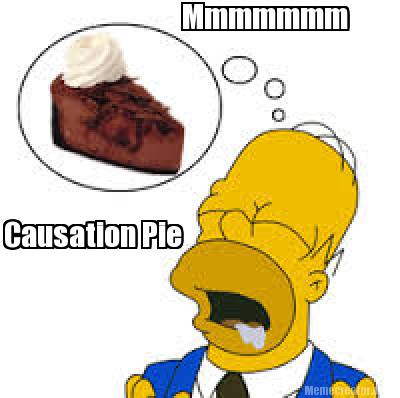
At his deposition, the doctor was repeatedly pressed to make a determination as to what percentage of the cause of the death could be attributed to the industrial medication.  While comparing an attempt to quantify the percentage to throwing a dart at a dart board while blindfolded, the AME did analogize the industrial-injury medication to crumbs and crust of the “causation pie.”

Causation Pie (Homer Simpson)Causation Pie (Homer Simpson)

However, the AME maintained his position that the applicant’s death was the result of an additive drug interaction between two drugs prescribed for non-industrial purposes.

Generally speaking, for a death to be compensable, it doesn’t have to be exclusively caused by industrial factors.  Of course, death on the jobsite usually means there is a compensable claim, but the theory can be stretched from pretty far away from the factory floor to a reasonable tie in to work.

Labor Code section 3600 restricts compensability in cases of death when the injury proximately causes death, and, in this case, it’s hard to say that the death of the worker was proximately caused by the injury, when it was the interplay of drugs prescribed for non-industrial causes that resulted in his death.  The fact that the AME conceded that it was possible that there was a “crumb” in the causation pie does not satisfy the proximate cause test.

After all, had he taken no drugs for pain management of his industrial injury, it appears that the injured worker is more likely than not to have suffered the same fate.

So, what can we get from this case?  Well, unfortunately, this is an unpublished decision, so we’re not going to get any sort of authority.  However, generally speaking, we can see that the Court of Appeal is disinclined to allow the imposition of death-benefits liability for a case where industrial injury proves such a small factor in the injured worker’s death.

Mileage Rate Reimbursement Decreases to $0.56 per mile for 2014

Your humble blogger welcomes you back from your weekend with this humble post.  As 2014 irresistibly approaches, and time refuses to stand still, taking with it our youth and giving us by way of trade closer deadlines, we should not be caught unawares of the new mileage reimbursement rate for injured workers.

The IRS has announced that the mileage reimbursement rate for 2014 will be 56 cents (down from 56.5 cents for 2013).  This means that injured workers (and attorneys) can claim half a cent less per mile traveled.

It might not seem like much, but, as we learned from Superman and Office Space, fractions of cents add up over time.

In any case, be prepared to amend your reimbursement procedures, because you can bet that everyone who can will try to get that half-cent from you come 2014!

Even After Death, MSA Must Still Be Funded

Today’s blog post comes straight out of the North Carolina Court of Appeals (hat tip to KC).  No, it doesn’t have any control over our lives, but it serves as a cautionary tale for us here in the workers’ paradise of California.

Here’s the skinny – parties agree to resolve a workers’ comp case and the settlement terms include the conditions for setting up the Medicare Set-Aside, including some seed money.  Well, before payment is made, the injured worker unfortunately passes away.

No dispute is raised about the various benefits promised as part of the agreement, except, of course, the MSA.  After all, the MSA isn’t just bonus money, but funds to pay for future medical treatment to avoid shifting the responsibility of the employer/insurer onto the federal government.  9 out of 10 doctors agree that most medical treatment is ineffective when applied to the deceased, and the fee schedule specifically excludes psychics, resurrections, and various poltergeists.

So, a defendant in this case would express condolences to the widow or widower and apply those previously-earmarked MSA funds to another project or case.

Well, not so fast!

The Court of Appeals in North Carolina, in reviewing the case of Carolyn G. Holmes (widow)  v. Solon Automated Services, the defendant, as part of the settlement agreement, promised to fund an MSA with $19,582.37 seed money and payments of about $9,200 annually for 18 years, only if the applicant was still living.

The Court of Appeals held that the annuity was self-negating as per the terms of the settlement.  Mr. Holmes failed to live even a year after the mediation that resulted in the settlement agreement, and therefore the yearly payments of about $9,200 were not an obligation upon the defense.

However, the seed money was owed to the applicant from day 1, and so was ordered pay it.

So, we’re back to this issue, which has been touched upon before just this week.  The money for medical treatment isn’t really for medical treatment, it’s just money.

So, again, perhaps language should be inserted to document an understanding of what will happen in the event of the injured worker’s death at any point – and also confirming that the funds set aside for medical treatment are only being provided in anticipation of medical treatment, and that death severs this obligation.

Employer Goes Down for WC Fraud; Lied About No. of Employees and Payroll

Jack sat in his office, high above his warehouse floor, where his insurance agent, Mark, explained to him why his workers’ compensation insurance premium was so high.  Jack understood that certain classes of employment increased his costs for insurance, as did the number of employees he had.

So, if he had fewer workers, and they were all clerical workers, he was likely to have a lower premium than if he had more workers doing hazardous work.

So, naturally, Jack decided that he would tell Mark he had five employees (not 25), and they were almost all office workers.

Mark looked out the window and saw the two dozen warehouse employees picking up heavy items and loading them into trucks before driving off to make deliveries.  “Yeah, you’re going to need to find a new insurance agent… this looks like fraud.”

Your humble blogger has a few friends in the insurance industry, and this happens more often than I would like to believe.  A lot of business owners are trying to make ends meet, and they often have to choose between lying about how much coverage they need to have or operating without coverage at all.

We’ve seen it on this blog several times, often with disastrous results for the employer, the injured worker, the injured worker’s family, and all the tax payers and policy holders who had to pick up the slack.

Well, enter now, the story of Richard Lopez Escamilla, Jr., who last week was sentenced to six years in prison for one felony count of insurance fraud, and was ordered to pay restitution in excess of $4 million to SCIF and SeaBright Insurance.

Apparently, Mr. Escamilla lied to his insurers about the number of employees he had, their payroll, and the history of past injuries.

As a result, he paid lower premiums and had an economic edge over his competitors (at least the ones that weren’t doing the same thing).

Look, if you’re an employer, this is not what you want to do.  It’s tempting to cut corners, especially after the sticker shock of your workers’ comp premium.  But, at the same time, you’re going to have a hard time running your business from behind bars, and a fraud conviction is not something anyone forgets about.

That being said, let’s not forget what is driving businesses to these methods in the first place.  We can shake our heads at these evil businessmen who don’t care about their employees and just want to squeeze another dollar out of the working man.  Or we can recognize that these employers are taking great personal risks to continue providing employment to people that need it, and that often have to choose between closing their doors or rolling loaded dice.

Remember, folks, we don’t ask the employees if they want to be covered by workers’ comp, or if they would rather have a higher paycheck (or even a job, in some cases).  We tell the worker he has to take the coverage, and we tell the employer he has to provide it.  No one cares if there is a better solution out there.

But, then again, that’s California.